Make delegation workDelegationWorkflow cost
The cheapest agent can be the most expensive workflow
A ten-cent model call can leave an expensive job for its reviewer. A hypothetical cost model compares workflows on the cost of an accepted outcome, including setup, maintenance and break-even volume.
Analysis · hypothetical cost modelPrepared October 22, 20268 min readRethinking Agents
What this rests on
Reported by others: METR's July 2025 developer study and its February 2026 design update, both re-read 2026-10-22; neither supplies an input to the model. Observed by us: none; no run was executed. Proposed: every workflow input is hypothetical, the arithmetic is reproducible from the published CSV, and no vendor price or achieved saving is claimed.
Sources checked October 22, 2026. Read the source record and limitations.
For engineers choosing between agents on price, and the owners who sign off on the savings they are promised.
All workflow numbers are hypothetical. No experiment has been executed.
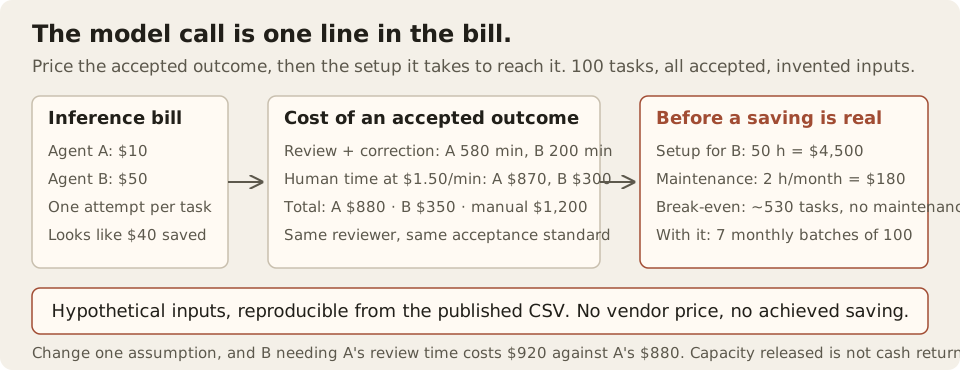
An agent costs ten cents to run. Another costs fifty cents. You have a hundred tasks waiting. Choosing the first appears to save forty dollars.
That comparison ends before anyone has used the output.
Someone still has to establish whether the work meets the requirement. They may need to reconstruct a source, resolve an ambiguity or start again. Those activities belong to the workflow just as much as the model call does. A cheap draft can leave an expensive job for its recipient.
The useful comparison is the cost of obtaining an accepted outcome. Define that outcome before deciding which price to optimize.
Give both systems the same finish line
Consider a fictional task: checking a short technical comparison against a supplied evidence packet. An accepted result identifies unsupported statements, preserves supported ones and records unresolved questions. A reviewer applies the same standard to every result, including work produced manually.
The ordinary-time assumptions include per-task preparation and checking; batch-independent setup is accounted for later.
This is a narrow checking task. It is not the full research assignment from the previous article. The times below would be implausibly precise estimates for open-ended research; here they are deliberately invented inputs for understanding a decision.
Assume 100 assigned tasks, all ultimately accepted after any necessary human correction. Value active human work at US$90/hour, or $1.50/minute. This is a sensitivity assumption, not a salary, vendor quote or estimate of any particular person's time value.
| Line | Manual | Agent A | Agent B |
|---|---|---|---|
| Ordinary work or review | 800 min | 400 min | 150 min |
| Cases needing additional correction | Included in ordinary time | 30 | 10 |
| Additional correction time | Included above | 180 min | 50 min |
| Total active human work | 800 min | 580 min | 200 min |
| Human time value | $1,200 | $870 | $300 |
| Inference expense | $0 | $10 | $50 |
| Total variable cost | $1,200 | $880 | $350 |
| Variable cost per accepted task | $12.00 | $8.80 | $3.50 |
A requires four minutes of ordinary review per task, then six additional minutes for each of 30 corrections. B requires 1.5 minutes of review, then five additional minutes for each of ten corrections. Each agent makes one attempt per task; correction is manual and involves no further inference in this example.
B spends five times as much on inference and has a much lower total. Its advantage comes entirely from the assumed human-work reduction. Nothing here establishes that a more expensive model would deliver it. Better source presentation, narrower scope or a useful automated check might produce the same reduction.
Keep failures in the bill
An accepted-task denominator must not hide unsuccessful work. Record every assigned task, every attempt, every retry and every fallback. Divide the complete batch cost by the number accepted, and report the acceptance fraction alongside it. Repeatedly attempting an easy task does not create multiple useful outcomes.
For a separate hypothetical example, spending $350 across 100 assigned tasks and accepting only 80 gives $4.375 per accepted task, with 80% acceptance. It does not justify comparison with a workflow delivering all 100. The missing outcomes may be the difficult, valuable ones. Either include the cost of recovering them or explain why reduced coverage meets the requirement.
Equal acceptance criteria also need credible checking. Faster review that silently misses more errors has changed the product. Have a common review procedure and inspect samples of accepted work for escaped errors. Record delayed corrections when they become visible. A short evaluation cannot establish the absence of rare failures.
There are two clocks
Active human time measures preparation, review, intervention and recovery. Elapsed time measures how long the task takes to reach acceptance, including queues and machine execution.
An unattended twenty-minute run may consume two minutes of human attention. It may still be unsuitable for a decision needed in five minutes. Conversely, a quick run that interrupts someone six times can impose more operating work than its duration suggests.
Track both clocks. Record blocked waiting separately from time spent doing something useful elsewhere. When tasks overlap, allocate active work once; do not charge the same minute to three agents. Measure context recovery where practical rather than adding an arbitrary interruption penalty. The worked table contains no latency assumptions and cannot support a speed claim.
METR's July 2025 randomized study illustrates why perceived benefit needs checking: 16 experienced open-source developers completed 246 tasks, with longer completion times when AI was allowed despite perceived speedup. Its population, tasks and early-2025 tools limit transfer. It is not a current verdict on coding agents. Original study (opens in a new tab)
In February 2026, METR described problems with its follow-up, including participant and task selection and difficulty timing concurrent agent work. The authors considered the data an unreliable signal of current productivity effects. These studies motivate measurement discipline; neither supplies an input to our table. Research update (opens in a new tab)
The first batch pays for the setup
Variable cost is only one part of an adoption decision. Suppose B requires 50 hours to build and establish its acceptance checks: $4,500 at our assumed rate. Compare this new investment with the existing manual process; this is not an all-in comparison with A, whose setup has not been estimated.
B saves $8.50 of variable cost per accepted task against manual work. With no maintenance, recovering setup requires $4,500 ÷ $8.50: approximately 530 tasks, or the sixth batch of 100. The first 100 tasks cost $4,850 including setup, against $1,200 manually.
Now assume two hours of maintenance each month, worth $180, and steady demand for 100 tasks monthly. Monthly savings fall from $850 to $670. Setup recovery takes about 6.72 months on a continuous-volume approximation; seven complete monthly batches are needed. At 1,000 tasks monthly, the same maintenance assumption gives $8,320 monthly savings and recovery in the first monthly batch. That volume must be useful demand, not work invented to justify the system.
Maintenance includes checking changes in sources, tools and requirements. If the workflow becomes obsolete before recovery, the projected savings never arrive. Existing setup expenditure is sunk when choosing how to run tomorrow's task, but belongs in evaluating whether the original investment paid off.
Capacity is not cash
The table combines inference cash expense with an assumed value for human time. A salaried team does not receive $900 back because B releases 600 minutes. Payroll may stay constant while API spending rises by $50.
Released capacity can be valuable if it supports useful additional work, avoids overtime or reduces a bottleneck. Record what actually happens to it. Fragmented spare minutes and an uninterrupted afternoon need not have the same value. Keep a cash ledger and a capacity account; do not label their sum cash savings.
Change one assumption and the winner changes
Suppose B needs the same review and correction as A: 580 human minutes. Its total becomes $920, versus A's $880. Paying more for inference buys no measured benefit in this reversal. Both remain below manual variable cost under these assumptions, before their respective setup and maintenance costs.
Equally, a system could justify higher cost by enabling worthwhile coverage that manual work never provided. Assess that additional outcome separately. Calling it time saved invents a manual baseline that did not exist.
Before choosing, collect the assigned and accepted counts, all-attempt expense, active human time, elapsed time, correction reasons, escaped errors, setup effort and maintenance burden. Use the worked cost model to expose assumptions, then replace them with observations from comparable tasks. Every row in it carries its unit and the calculation or assumption behind it, so a reader can change one input and watch the ranking move. The cheapest useful workflow is the one that reaches the required outcome at an acceptable total cost. A model price alone cannot tell you which one that is.
Next: What does an agent need to remember?, on preserving the evidence and decisions that the next run depends on.
Source record: sources, evidence status and fictional elements for the whole series. Apply the series: Delegation review kit.
Found an error or a missing boundary? Send a correction or question. Please omit private traces and credentials.