Make delegation workDelegationParallel agents
When more agents are worth it
Parallel work can buy useful capacity when its returns fit together. Compare independent research branches with a software change whose shared contract must come first.
Analysis · illustrative schedulesPrepared October 22, 20268 min readRethinking Agents
What this rests on
Reported by others: Anthropic's June 2025 multi-agent research report, re-read 2026-10-22. Observed by us: none; no multi-agent run was executed, and the schedule arithmetic is illustrative—neither elapsed nor summed time establishes token cost or human effort. Proposed: both decompositions and the filled worker return are fictional designs, NOT RUN.
Sources checked October 22, 2026. Read the source record and limitations.
For engineers deciding whether a task deserves several agents, and the reviewers who have to combine what comes back.
Find the work that can proceed independently, then price the work of bringing it back together.
Three agents investigate three candidates. Each returns a report. The coordinator combines them into a recommendation.
That sounds like a sensible research system. But one worker compared the cheapest plan, another assumed enterprise permissions, and the third treated estimated costs as quotes. The coordinator now has three incompatible answers to repair.
Delegation created activity. Whether it created useful capacity depends on the task boundary and the evidence returned.
There are jobs where several agents can explore more possibilities, inspect larger source collections or finish sooner. There are also jobs where each additional worker needs yesterday's decisions before doing anything useful. Draw that distinction before choosing an agent count.
Start with a shared question
Return to our fictional documentation-search dossier. The owner wants to choose a prototype, with private shared access, source links, updates within 24 hours, a two-day prototype limit and a $60 monthly cash cap. All details below are teaching examples; no agents were run.
The three candidates have separate proposal documents. That creates a possible division:
| Stage | Assignment | Return artifact |
|---|---|---|
| Before delegation | Coordinator fixes the decision and requirements from F01 | One shared comparison rubric |
| Concurrent branch A | Inspect existing-site design, F02 | Requirement evidence, estimates, missing checks |
| Concurrent branch B | Reconcile hosted-search documents, F03/F04 | Plan-specific facts, ambiguity resolved, integration unknowns |
| Concurrent branch C | Inspect semantic design, F05 | Scope/effort fit, unsupported quality assumptions |
| After returns | Coordinator compares all three against F01 and owner tasks F06 | Prototype recommendation, objection and next validation |
Each worker can inspect its source set without waiting for another worker's conclusion. All need the same requirements. None needs authority to rewrite them.
For this tiny pack, one agent reading the six cards sequentially is a credible starting design. Delegation becomes more attractive if each branch contains substantial independent investigation. The topology stays useful even when the current workload does not justify parallel execution.
Specify a return you can actually use
“Research B” leaves too much room for interpretation. Here is a completed return under a more precise contract. The card IDs refer to the fictional dossier, not external product evidence.
| Field | Worker B's illustrative return |
|---|---|
| Question | Does B plausibly meet today's requirements for a prototype? |
| Sources inspected | F01 owner constraints, dated 2026-09-15; F03 overview, 2026-06-01; F04 plan specification, 2026-09-10 |
| Supported claims | F04 specifies $40/month at scenario volume, source links and a shared collection; consuming application enforces authentication |
| Ambiguity resolved | F03 mentions filtering and a $40 plan without assigning the feature to that plan. F04 places per-team filtering on the $90 plan |
| Uncertainty | The 15-minute update figure is a target. Integration effort and maintenance are unspecified; authenticated serving behavior is untested |
| Decision implication | Today's shared-access requirement may fit. Future per-team filtering exceeds the cash cap on the specified plan |
| Conclusion boundary | Candidate remains plausible; neither prototype-effort compliance nor deployment readiness is established |
| Next decisive check | Estimate the integration required to enforce access within the two-day prototype limit |
This gives the coordinator material it can compare. “B supports access controls” would conceal the application responsibility and the distinction between today's requirement and a possible future one.
A worker that cannot inspect an assigned source should return that gap. Reassign it, narrow the recommendation or stop. Silence must not become a satisfied requirement during synthesis.
Parallel findings still need one coherent decision
In the dossier, A deserves the first prototype because its proposal fits the effort estimate and current requirements, subject to implementation checks. C exceeds the effort limit on its present estimate. B remains a plausible alternative with integration effort unresolved. Those are implications of the supplied fictional evidence, not measured product rankings.
The synthesis step must preserve those qualifications. If it replaces “proposed authenticated boundary” with “secure,” it has damaged the research despite accurate worker returns.
Source independence also needs checking. Two workers finding the same supplier announcement through different articles have one underlying claim, not two confirmations. Separate contexts can diversify investigation; they do not automatically create independent evidence or errors.
A good coordinator checks decisive source passages and resolves requirement mismatches. It should not need to repeat every search. If it does, the return contract or decomposition has failed to save that work.
Where parallel research can earn its cost
Anthropic's June 2025 engineering report describes a lead researcher dispatching parallel investigations and synthesizing their findings. It reports an internal evaluation improvement alongside substantial extra token use, and identifies shared-context dependencies as a constraint. This is a useful vendor-reported case, based on its system and model generation; it does not establish superiority at equal cost or current performance for our designs. Primary engineering report (opens in a new tab)
Consider an explicitly hypothetical larger comparison: three investigations each take 12 minutes, followed by six minutes of synthesis. Serial execution takes 42 minutes. Concurrent execution with three minutes of dispatch overhead takes 21: three to dispatch, 12 for the branches, six to synthesize.
That halves elapsed time under the assumptions. It also raises summed execution time from 42 to 45 minutes. These are illustrative calculations, not runtime observations. Neither figure measures human attention or token cost. A slow worker, shared rate limit, retry or harder synthesis changes the result.
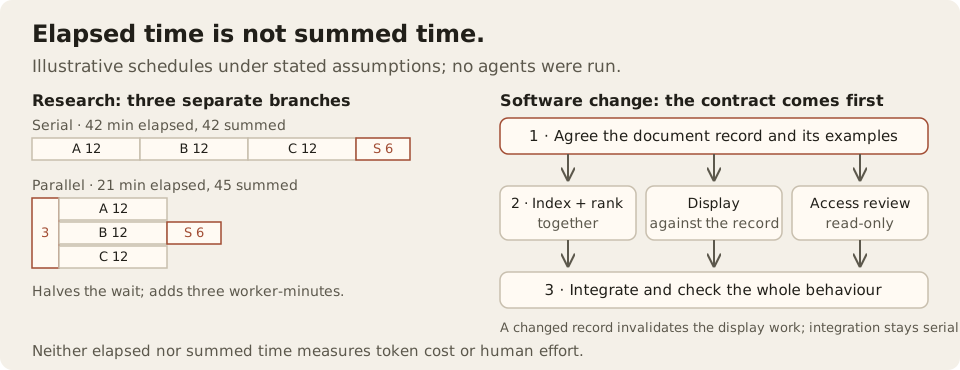
The constructive case is a valuable decision with genuinely separate evidence branches and a meaningful deadline. Paying more to produce a reviewable answer sooner may be sensible. The benefit must survive aggregation.
A software change with a different dependency shape
Now suppose the fictional documentation site needs obsolete search results visibly labelled and current authoritative documents ranked above them. This is a proposed coding task, not a change implemented here.
Assigning separate workers to indexing, ranking and rendering looks tidy. It can still produce incompatible behavior: the indexer records age, the ranker expects an explicit replacement relationship, and the renderer labels anything old as obsolete. File ownership prevents overlapping edits; it cannot settle the meaning of “current.”
A workable decomposition first establishes that meaning:
| Order | Work | Dependency and acceptance evidence |
|---|---|---|
| 1 | Agree a hypothetical document record with an explicit replacement relationship | Include an old but still authoritative document and an explicitly superseded one |
| 2 | Implement indexing and ranking together | Preserve that relationship; demonstrate authoritative results outrank their obsolete versions in the agreed cases |
| Concurrent with 2 | Prepare display behavior against the agreed record | Show the obsolete label without treating age alone as obsolescence |
| Concurrent with 2 | Review existing serving paths, without editing them | Identify where index, title or snippet access checks need verification |
| 3 | Integrate and check complete search behavior | Verify ranking, labels and signed-out denial on the combined artifact |
The schema and examples precede dependent implementation. A changed record invalidates the display worker's assumptions and requires an explicit update. Integration remains a serial dependency.
For a small patch, one implementer following that sequence may finish with less context transfer. For a larger change with a stable contract, rendering and access review could justify parallel work. The decision follows the dependencies, not a blanket rule that coding needs one agent.
Compare against a capable serial alternative
A single agent can inspect candidates sequentially, adopt different review roles and call independent tools concurrently. Those are real alternatives. A “researcher” and “critic” label alone does not justify separate agents; nor does a simulated critic guarantee independent judgment.
Compare both designs with the same requirements, source access and acceptance criteria. Ask two questions:
- At a fixed total resource budget, which produces more acceptable decisions? Include dispatch, synthesis, retries and checking, not just worker calls.
- To reach a specified quality target, what does each cost? Report machine expense, elapsed time and active human review separately. A design that never reaches the target has no demonstrated cost of reaching it.
Record model choices and tool concurrency so their benefits are not attributed entirely to agent count. Check unsupported decisive claims, missed constraints and corrections required before accepting the output. More pages and more tokens are not the outcome.
Keep extra workers when independent work returns useful evidence and improves the accepted result enough to cover coordination. Narrow or remove them when duplicated investigation, inconsistent assumptions or synthesis repairs consume that gain.
The useful unit of delegation is a question someone can answer with a checkable return. Find enough of those, and several agents can earn their place.
Previous: Your coding agent's reviewer needs evidence, on what a reviewer should inspect, return and leave explicitly unverified.
Source record: sources, evidence status and fictional elements for the whole series. Apply the series: Delegation review kit.
Found an error or a missing boundary? Send a correction or question. Please omit private traces and credentials.